Good literacy teaching rests on a handful of big ideas about how children learn to read, write and use language. I've gathered the frameworks and the research behind them here, so you can see where our practice comes from and explain it with confidence.
The Simple View of Reading 5
Reading comprehension is the product of decoding and language comprehension, so a reader needs both, and a weakness in either one limits understanding. Philip Gough and William Tunmer proposed it in 1986, and Wesley Hoover and Gough set it out more fully in 1990.
Linda Farrell, Michael Hunter, Marcia Davidson and Tina Osenga, Reading Rockets · Article · USA
A plain explanation of the model, in which reading comprehension depends on both decoding and language comprehension. It shows how to work out which of the two is holding a student back.
Reading Universe · Slides for a staff session · USA
Ready-made slides for leading a staff session on the Simple View of Reading, with the research explained, discussion questions, videos of model lessons and classroom resources.
Kate Nation · 2019 · Open access · Australian Journal of Learning Difficulties
Kate Nation's open-access review of the Simple View of Reading. It sets out what the model explains well about reading and reading difficulties, and where language and reading are more entangled than the model suggests.
Wesley Hoover talks through the Simple View of Reading and how the Cognitive Foundations Framework extends it. The podcast is produced by a publisher, Voyager Sopris Learning.
Hollis Scarborough's picture of skilled reading as many strands, some for word recognition and some for language comprehension, woven together and strengthened through teaching and practice.
Melissa and Lori Love Literacy, with Hugh Catts · About 23 minutes · USA
Reading researcher Hugh Catts joins the Melissa and Lori Love Literacy podcast to talk about the Simple View of Reading and Scarborough's Reading Rope. This is the video of episode 178.
Kaia Cunningham, Landmark Outreach · Article · 2022 · USA
Introduces Hollis Scarborough's 2001 Reading Rope, showing how the word recognition and language comprehension strands combine in skilled reading, and how teachers can use it to find where a reader is stuck.
Pamela Snow pictures language and literacy as a house. The solid ground is the warm, responsive relationships of a child's first two years, and the foundations are the oral language built across the first five. Two walls rise together and hold each other up, with reading, writing and spelling on one side and the language skills for getting along with others on the other. Social and emotional wellbeing and social cognition form the rafter, and the roof is a young person's way into further education, training and work.
A short video on building the language house from Spelfabet, the site run by Australian speech pathologist Alison Clarke. It runs for about nine minutes.
Teaching Literacy Podcast, with Pamela Snow · About 55 minutes
Pamela Snow joins the Teaching Literacy Podcast to talk about SOLAR, the Science of Language and Reading, the framework her Language House illustrates. This is the video of episode 21.
Pamela Snow, The Snow Report · Blog post · 2020 · Australia
Pamela Snow walks through her Language House on her blog, from the solid ground of early relationships up to the roof. She welcomes teachers using the model with attribution.
Pamela Snow · 2020 · Open access · Child Language Teaching and Therapy
Pamela Snow's paper proposing the Science of Language and Reading framework, which places oral language at the centre of learning to read. It sets out her Language House in full.
Joan Sedita's Writing Rope sorts the skills of writing into five strands, which are critical thinking, syntax, text structure, writing craft and transcription. The Simple and Not So Simple Views of Writing explain how handwriting and spelling, composing and self-regulation share a writer's limited working memory. For teaching writing day to day, see Writing.
Reading Rockets, with Steve Graham · About 40 minutes · USA
A Reading Rockets video with writing researcher Steve Graham on effective writing teaching. Pairs well with the Karen Harris podcast episode on self-regulated strategy development on the Listen shelf.
A short Reading Universe video that answers the question in its title. At under ten minutes, it is a quick way to introduce the Writing Rope to a team.
Reading Universe, with Joan Sedita · About 53 minutes · USA
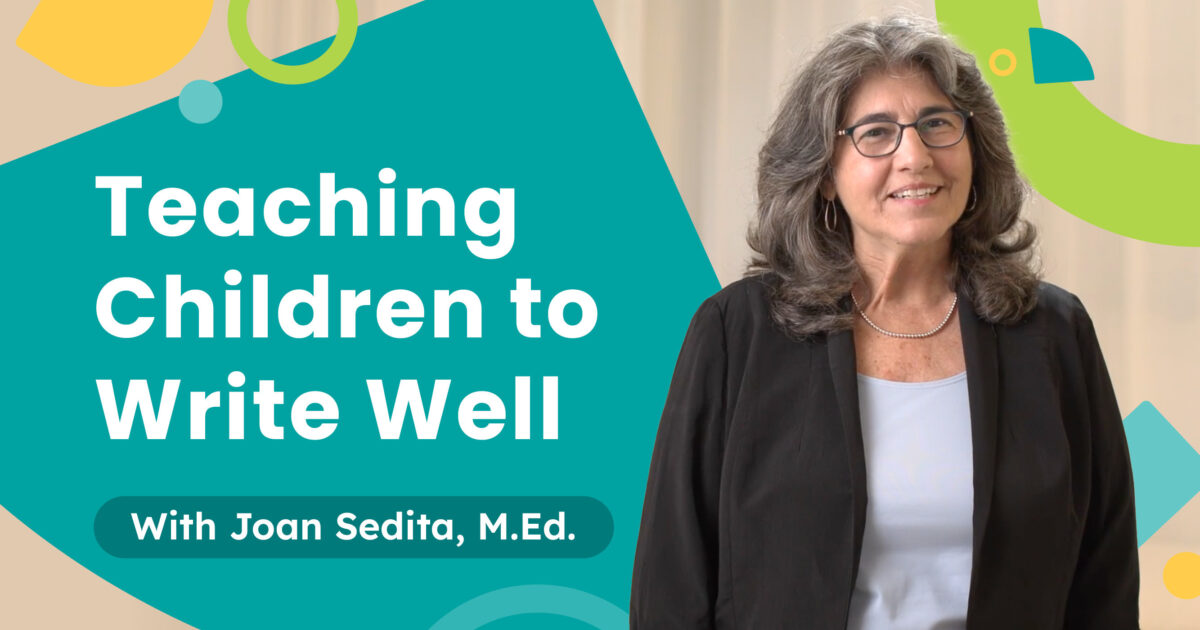
Joan Sedita, founder of Keys to Literacy, presents her Writing Rope and shows how thinking, language, structure and craft weave together, using real student work and classroom video.
A PaTTAN playlist of five sessions on the Writing Rope. The first introduces the rope and what is known about effective writing instruction, and it suits a team working through the framework over a term.
MiMTSS Technical Assistance Center · About 1 hour 20 minutes · USA
A session from the MiMTSS Technical Assistance Center on the Not So Simple View of Writing. It runs for about 80 minutes, and the presenter is not named in the title.
Joan Sedita, Keys to Literacy · Article (PDF) · 2019 · USA
Joan Sedita's own article introducing the Writing Rope, which sorts the skills of writing into five strands, namely critical thinking, syntax, text structure, writing craft and transcription.
Carl Hendrick (The Learning Dispatch) · Substack · 2026 · UK
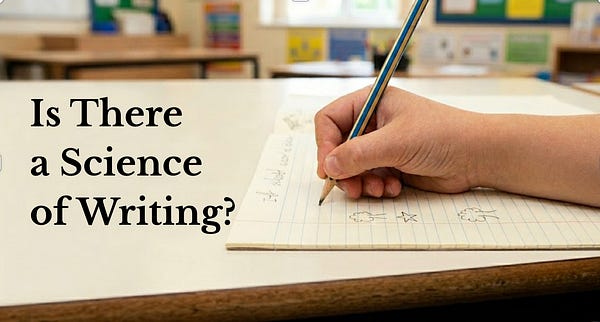
Hendrick asks why writing research, which is substantial, has had far less influence than the science of reading, and outlines what the evidence says about teaching writing.
Susan Lambert draws on past episodes with Steve Graham, Young-Suk Grace Kim, Natalie Wexler and Judith Hochman to give an overview of science-based writing instruction.
The Structured Literacy Podcast · with Jocelyn Seamer
Jocelyn Seamer sets out the research foundation for integrating reading and writing instruction, including Fitzgerald and Shanahan's shared knowledge framework.
The National Reading Panel named five components of reading instruction, which are phonemic awareness, phonics, fluency, vocabulary and comprehension. Deslea Konza added oral language and early literacy experiences to give Australian schools the Big Six.
NSW Department of Education · Short videos · F-2 · Australia
Deslea Konza explains where phonics sits among the Big Six of reading, followed by two brief clips of explicit phonics lessons with a whole class and a small group.
Deslea Konza, for the South Australian Department of Education and Children's Services · Research into practice paper (PDF) · 2010 · Australia
A short, readable paper that pulls the big reading reviews into six components, from oral language and phonological awareness through to fluency and comprehension. Good pre-reading for a staff meeting.
National Reading Panel (NICHD) · 2000 · Foundational research · USA
The summary report of the United States National Reading Panel, the review behind the five components of phonemic awareness, phonics, fluency, vocabulary and comprehension.
Educational linguist Lyn Stone discusses literacy instruction and the Big Six components of reading, with plenty for teachers wanting a clear overview.
How children move from sounding out to recognising words instantly, including Ehri's phases, orthographic mapping and what brain research shows. For teaching it, see Phonics.
Carl Hendrick (The Learning Dispatch) · Substack · 2026 · UK
Hendrick explains research suggesting children form an early guess at a word's spelling from hearing it, which helps explain why oral vocabulary supports later reading and spelling.
Harriett Janetos (Making Words Make Sense) · Substack · 2025 · USA
Janetos unpacks Linnea Ehri's own explanation of orthographic mapping, clearing up confusion about the term and what it means for teaching children to read and spell words.
Explains why skilled readers recognise words through orthographic mapping rather than visual memory, and the role of phonemic awareness and phonics in building that store of words.
The major reviews, inquiries and reports that pull the reading research together, from Australia's 2005 National Inquiry and England's Rose Review to Ending the Reading Wars. Structured literacy sits here too, meaning explicit, systematic and cumulative teaching of how language works, from sounds and spellings through to word parts, sentences and meaning.
Mornington Peninsula Foundation, with Pamela Snow · 2025 · Australia
Pamela Snow's 2025 La Trobe Oration asks why reading instruction is still contested after decades of research, what has slowed research reaching classrooms, and what needs to change in teacher education.
PaTTAN, with Louisa Moats · About 51 minutes · USA
Louisa Moats talks with PaTTAN about the 2020 edition of Teaching Reading Is Rocket Science. It pairs well with reading the paper itself, which is also in this section.
AERO's overview of how children learn to read. It introduces the Simple View of Reading, Scarborough's Reading Rope and the core reading skills, and explains why explicit, systematic teaching matters.
The Reading League's guide to what the science of reading is and what it is not. The free eBook is a helpful shared reference when the term is being used loosely.
International Dyslexia Association · Article · USA
The International Dyslexia Association explains structured literacy, covering what is taught, from phonemes to sentence structure and meaning, and how it is taught, explicitly, systematically and cumulatively.
Willingham explains why the term science of reading is used loosely, separating what basic research shows about reading from claims about classroom practice.
Ken Rowe and the National Inquiry into the Teaching of Literacy · 2005 · Foundational research · Australia
The report of Australia's 2005 national inquiry, which reviewed the research on teaching literacy and how well new teachers were being prepared to teach reading.
Jim Rose, for the Department for Education and Skills · 2006 · Foundational research · UK
Jim Rose's 2006 review of the teaching of early reading for the Department for Education and Skills in England. Free to download from the Digital Education Resource Archive.
Petscher, Cabell, Catts, Compton, Foorman and colleagues · 2020 · Open access · Reading Research Quarterly
Twelve researchers from the Florida Center for Reading Research sort the claims made for the science of reading into those with compelling evidence, promising evidence and little evidence. Free on PubMed Central.
Education Research Reading Room · with Pamela Snow
Professor Pamela Snow, a psychologist and speech pathologist, discusses phonics and reading instruction, and how adults can draw accurate accounts from children and young people.
Pamela Snow reflects on the long push for evidence-based reading instruction and why changing practice takes effort from the whole education community.
Emily Hanford, APM Reports · Audio documentary and article · 2018 · USA
Emily Hanford's documentary on what research shows about how children learn to read, why many educators do not know that science, and how one Pennsylvania district set about changing its teaching.
Education Research Reading Room · with Jennifer Buckingham
Jennifer Buckingham compares literacy instruction and policy in the UK, Ireland and Australia, including curriculum, teacher education, assessment and inspection, and how these affect results.
Emily Hanford's investigative podcast on how children learn to read and why the research often does not reach classrooms. A second season looks beyond reading to teaching itself.
Why reading comprehension is not one general skill, and how much a reader's knowledge of words and the world shapes what they understand. For classroom practice, see Reading comprehension and text study.
Read Ballarat, with Stephanie Le Lievre · About 65 minutes · Australia
Stephanie Le Lievre presents a knowledge-based model of reading comprehension in a session for Read Ballarat. Useful for teachers rethinking how comprehension is taught.
Melissa and Lori Love Literacy, with Hugh Catts · About 56 minutes · USA
Hugh Catts joins the Melissa and Lori Love Literacy podcast to talk about rethinking reading comprehension. This is the video of episode 118, and it pairs with his American Educator article.
Daniel Willingham, American Educator · Article · 2006 · USA
Daniel Willingham explains why knowledge is more than grist for the mill, and how what students already know speeds and strengthens their reading comprehension, learning and thinking.
Hugh Catts argues that reading comprehension is not a single skill that can be taught and tested on its own, because it depends on the reader's knowledge, the text and the purpose for reading.
Carl Hendrick (The Learning Dispatch) · Substack · 2026 · UK
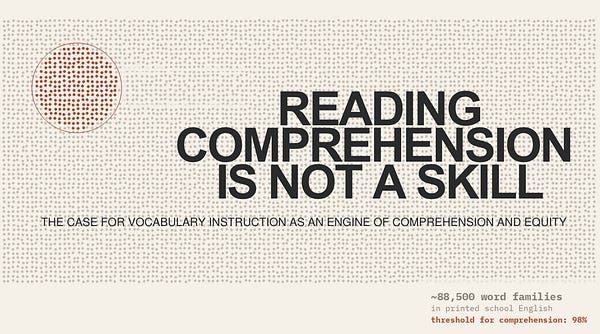
Drawing on new research and his own teaching, Hendrick argues that comprehension depends far more on knowing word meanings than on generic strategies, and makes the case for rich vocabulary teaching as an equity lever.
Natalie Wexler (Minding the Gap) · Substack · 2025 · USA
Wexler untangles competing claims that schools teach too little or too much comprehension, tracing the debate back to Durkin and arguing that literacy and content teaching must work together.
Doug Lemov (Doug Lemov's Field Notes) · Substack · 2026 · USA
In an excerpt from his guide to the science of reading, Lemov explains why the hope of teaching transferable comprehension skills is a chimera, and why inference and understanding depend on knowledge.
Olivia Mullins (The Curriculum Insight Project) · Substack · 2026 · USA
Olivia Mullins responds to a meta-analysis questioning content-rich teaching for comprehension, explaining why its design does not overturn evidence that knowledge supports reading comprehension.
FreeOpens at curriculuminsightproject.substack.com
Reid Smith, Pamela Snow, Tanya Serry and Lorraine Hammond · 2021 · Open access · Reading Psychology
An open-access critical review of the research on the part background knowledge plays in reading comprehension, published in Reading Psychology in 2021.
Natalie Wexler discusses what drives reading comprehension and why knowledge-rich instruction matters for every learner, drawing on The Knowledge Gap and Beyond the Science of Reading.
An EEF panel including Kate Cain discusses the reading comprehension house from the guidance report Improving Literacy in Key Stage 2 and how it supports teaching.
Education Research Reading Room · with Natalie Wexler
Journalist Natalie Wexler discusses The Knowledge Gap and her argument that building knowledge is central to reading comprehension in American schools.
Spoken language as the base that reading and writing are built on, and the Matthew effect, where early strengths or difficulties compound over time. For classroom practice, see Oral language.
Think Forward Educators, with Tanya Serry · About 70 minutes · 2026 · Australia
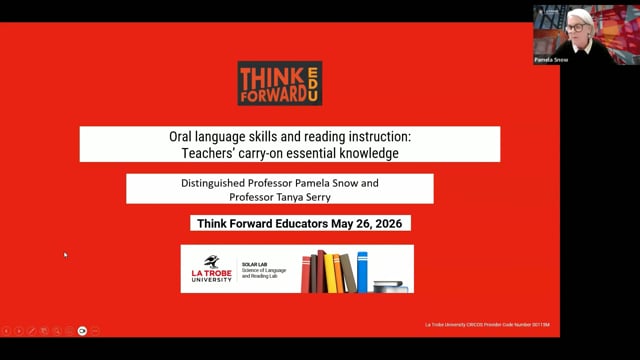
Professor Tanya Serry uses Nancy Hennessey's assembly line metaphor to explain the language foundations of reading comprehension, from word identification and vocabulary to syntax and background knowledge.
Children of the Code, with Keith Stanovich · About 6 minutes · USA
Keith Stanovich talks about Matthew effects in reading and whether reading makes you smarter, in a six-minute interview clip from the Children of the Code project.
Think Forward Educators, with Tanya Serry · 30 to 60 minutes · 2026 · Australia
Professor Tanya Serry's second session on the language foundations of reading comprehension, turning to what they mean for teaching reading and writing.
Deslea Konza, for the South Australian Department of Education and Children's Services · Research into practice paper (PDF) · 2011 · Australia
Deslea Konza explains how oral language shapes later reading, with classroom strategies such as wait time, simpler teacher talk, think-alouds, shared story books and daily table talk.
Pamela Snow · 2016 · Open access · International Journal of Speech-Language Pathology
Pamela Snow's Elizabeth Usher Memorial Lecture, published as an open-access paper, on where speech-language pathology sits in education policy, practice and debate.
Spelling draws on language knowledge, not visual memory alone. Good spellers draw on sounds, letter patterns and meaningful word parts together. For classroom practice, see Spelling and morphology.
The Reading League Illinois, with Lyn Stone · About 1 hour 30 minutes · USA
Lyn Stone presents on morphology and spelling for The Reading League Illinois. A long session for teachers wanting to deepen their knowledge of how words are built.
Learning Difficulties Australia, with Alison Clarke · About 1 hour · Australia
Melbourne speech pathologist Alison Clarke presents on spelling for Learning Difficulties Australia. Relevant to anyone supporting students whose spelling lags behind their reading.
Five from Five, with Alison Madelaine · About 1 hour · Australia
Dr Alison Madelaine's guest presentation for Five from Five on rethinking classroom spelling teaching. Strong Tier 1 spelling is the first support for students with written expression difficulties.
Louisa Moats on how spelling supports reading, and why English spelling is more regular and predictable than many people think. The article downloads as a PDF from this page.
Malatesha Joshi, Rebecca Treiman, Suzanne Carreker and Louisa Moats, American Educator · Article · USA
Four researchers make the case that spelling is an integral part of learning the language and not a matter of memorising. The article downloads as a PDF from this page.





 Carl Hendrick (The Learning Dispatch) · Substack · 2026 · UK



 Harriett Janetos (Making Words Make Sense) · Substack · 2025 · USA
 Jen O'Sullivan · Substack · 2025 · International


 Daniel Willingham · Substack · 2025 · USA



 Natalie Wexler (Minding the Gap) · Substack · 2025 · USA
 Doug Lemov (Doug Lemov's Field Notes) · Substack · 2026 · USA
 Olivia Mullins (The Curriculum Insight Project) · Substack · 2026 · USA